PAG SCPE™
STRUCTURED CAPITAL PROTECTION ECOSYSTEM
A Governance-First Capital Protection & Execution Framework
Introduction to Pacific Alliance Group (PAG)
Pacific Alliance Group (PAG) is a global governance, transaction-readiness, and strategic advisory ecosystem built on the principles of trust, transparency, fiduciary discipline, and structured capital protection.
Rather than operating as a conventional advisory or brokerage platform, PAG is structured as a multi-entity ecosystem, where each entity performs a distinct and independent role to ensure:
Institutional credibility
Conflict-free execution
Governance-led capital structuring
End-to-end transaction governance and risk oversight
At the core of PAG’s philosophy is a simple but powerful belief: Transaction should be independently verified, appropriately governed, and properly structured before counterparties proceed.
What is SCPE™
The Structured Capital Protection Ecosystem (SCPE™) is PAG’s proprietary institutional framework designed to:
Identify and mitigate transactions, counterparty, and fraud-related risks through structured verification and governance
Provide governance oversight throughout the agreed advisory engagement
Assess proposed transaction structures and institutional readiness in a controlled and documented manner
Relevant engagements are subject to appropriate due diligence, governance review, and risk assessment within the scope of PAG's contractual mandate
Structure capital access in a controlled and verified manner
Ensure fiduciary oversight at every stage of the transaction lifecycle SCPE™ is not a funding platform, and it does not provide guarantees. Instead, it ensures that: All capital-related engagements are verified, structured, supervised, and protected before, during, and after execution.
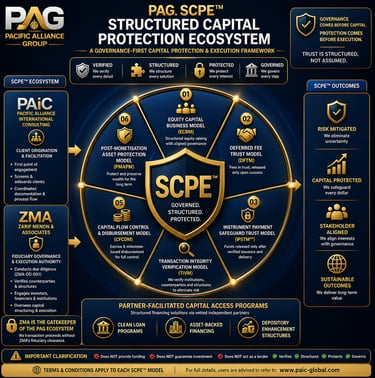
How SCPE™ Works (Ecosystem Structure)
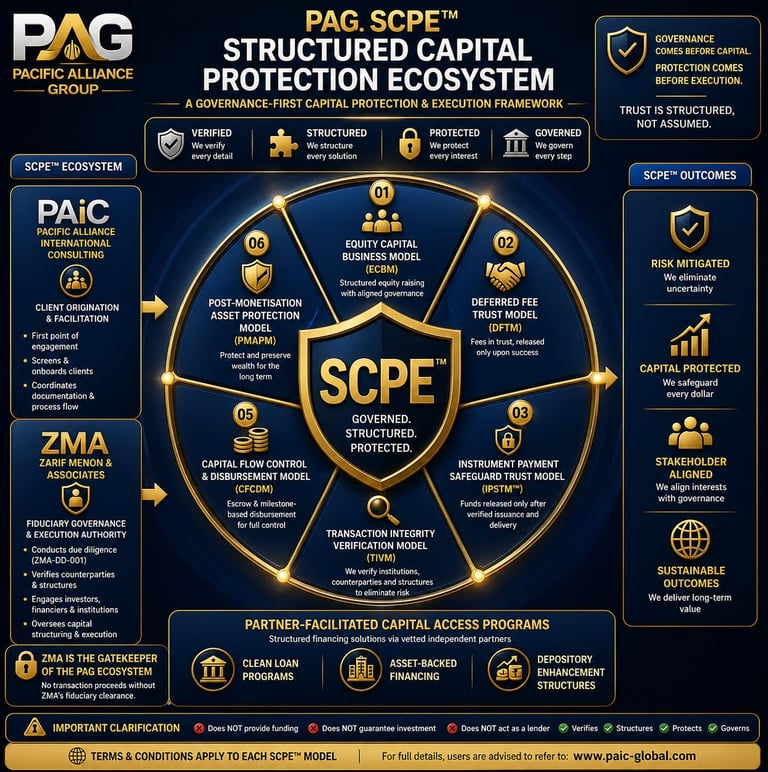
SCPE™ operates through two key entities within PAG:
Pacific Alliance International Consulting (PAiC) (Client Origination & Facilitation)
First point of engagement
Screens and onboards clients
Coordinates documentation and process flow

Zarif Menon & Associates (ZMA) (Fiduciary Governance & Execution Authority)
Conducts full due diligence (ZMA-DD-001)
Verifies counterparties and structures
Coordinates, where appropriate and lawfully permissible, engagement with independent institutions and professional counterparties
Provides governance oversight and transaction-readiness support in relation to proposed structures
ZMA acts as the Gatekeeper of the PAG Ecosystem.
No transaction proceeds without ZMA’s fiduciary clearance.
SCPE™ Core Governance Models
These are PAG’s proprietary protection and structuring models, designed to address specific capital challenges.
1.) Equity Capital Business Model (ECBM)
Purpose: Equity transaction-readiness, governance, and structural assessment.
When it applies:
Companies seeking investors for expansion
Infrastructure or development projects
What it does:
Assesses the suitability and readiness of proposed institutional counterparties, where independently identified or lawfully introduced
Reviews proposed equity structures from a governance, commercial-readiness and risk perspective, together with appropriately authorised professional advisors where required
Aligns governance between stakeholders
Example: A manufacturing company considering a USD 20M expansion undertakes institutional-readiness, governance and structural assessment before any engagement with independently selected or appropriately authorised capital-market counterparties.
2.) Deferred Fee Trust Model (DFTM)
Purpose: Reduce upfront financial burden
When it applies:
Clients hesitant or unable to pay large upfront advisory fees
What it does:
Fees are placed in trust
Released only upon success or milestones
Example: A developer engages PAG but prefers not to pay monthly fees directly — funds are secured in a trust account and only released when agreed milestones are achieved.
3.) Instrument Payment Safeguard Trust Model (IPSTM™)
Purpose: Protect clients from advance fee scams
When it applies:
SBLC, BG, LC, or monetisation transactions
Situations requiring upfront issuance or activation fees
What it does:
Funds are held in a trust account
Payment is only released after verified delivery
Example: A client asked to pay USD 500,000 for an SBLC issuance places funds into a trust structure. Payment is only released once the instrument is verified and delivered.
4.) Transaction Integrity Verification Model (TIVM)
Purpose: Verify legitimacy before commitment
When it applies:
High-risk or unclear transactions
Unknown counterparties
What it does:
Verifies institutions, platforms, and parties
Identifies red flags and risks
Example: A client approached by a “funding provider” undergoes verification — revealing inconsistencies that prevent a potential scam.
5.) Capital Flow Control & Disbursement Model (CFCDM)
Purpose: Control how funds move
When it applies:
Multi-party transactions
Large project funding
What it does:
Structures escrow and payment waterfalls
Ensures milestone-based disbursement
Example: A project with multiple contractors only receives payments when verified milestones are completed — eliminating misuse of funds.
6.) Post-Monetisation Asset Protection Model (PMAPM)
Purpose: Protect capital after success
When it applies:
After funding or monetisation
High-value liquidity events
What it does:
Implements trust structures
Ring-fences assets
Protects long-term wealth
Example: A client receiving USD 50M funding structures assets into protected vehicles to prevent creditor exposure and tax inefficiencies.
Partner-Facilitated Capital Access Programs
Where relevant to a client's requirements, independently regulated or appropriately authorised third-party institutions may provied financing or other financial solutions directly to eligible clients.
PAG does NOT provide, issue, arrange, underwrite, or guarantee such products or facilities.
Any engagement is independently assessed and contracted between the client and the relevant third-party subject to applicable law.
Independent financing, asset-backed, and institutional banking solutions may be considered where appropriate and provided directly by suitably authorised third-parties.
These are provided by independent third-party institutions, not PAG.
Important Clarification
SCPE™:
❌ Does NOT provide funding
❌ Does NOT guarantee investment
❌ Does NOT act as a lender
SCPE™:
✅ Verifies
✅ Structures
✅ Protects
✅ Governs
Why SCPE™ Matters
In today’s global financial environment:
Advance fee scams are widespread
Unverified intermediaries are common
Complex transactions carry hidden risks
SCPE™ exists to solve these problems by introducing:
Institutional governance
Fiduciary oversight
Structured protection mechanisms
Terms & Conditions
Each SCPE™ model operates under specific Terms & Conditions, including:
Engagement structures
Fee arrangements
Trust and escrow mechanisms
Governance protocols
Risk disclosures
👉 For full details, users are advised to refer to: www.paic-global.com
Final Statement
SCPE™ represents a new standard in capital facilitation — where:
Governance comes before capital.
Protection comes before execution.
Trust is structured, not assumed.